
A development tool
The R.E.A.L. Profile
It reveals our ability to switch from the brain’s “automatic and reactive” mode to its “adaptive and intuitive” mode, and gives practical ways to progress.
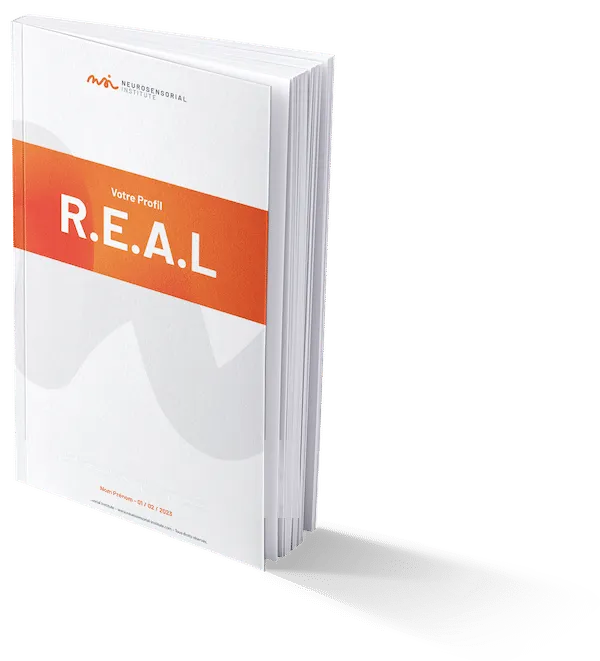
- 48questions based on neuroscience
- 24adaptive competencies analysed
- 4areas of adaptiveness
- ~50report pages with exercises
How the institute uses the profile
At Neurosensorial Institute, the R.E.A.L. Profile is the starting point of our courses: participants take it, discover which adaptive competencies are strong and which need work, and train them with simple practices from the neurosensory approach. Coaches, trainers and HR professionals can then get certified to offer it to their own clients, one to one or in teams.
To learn everything about the profile and take it, visit le-profil-real.com. Distribution and licensing partners: the-real-process.com.
The four steps of the R.E.A.L. Process
Two steps to collect information, two to regulate it, four competencies per step.
-

Taking responsibility
“I step back and take back my power to act.”
 Gain perspective
 Develop subjectivity awareness
 Take ownership
 Reclaim agency
-

Exploring
“I look at what is, with curiosity.”
 Accept what is
 Be fully present
 Observe objectively
 Activate curiosity
-

Aligning
“I act in line with what matters to me.”
 Be constructive
 Act from the heart
 Connect to strengths
 Commit
-

Letting go
“I trust and let things come.”
 Accept the unknown
 Adapt to the unknown
 Release the past
 Trust the future
Four areas of adaptiveness

Cognitive adaptiveness
Choosing, consciously or intuitively, a way of thinking that makes the switch to the adaptive brain easier.

Emotional adaptiveness
Awareness of what is going on inside you, and the quality of what you do to regulate your emotions.

Behavioral adaptiveness (DISC)
Avoiding the “trap behaviours” specific to each DISC® profile.

Adaptiveness to frustration
Avoiding automatic reactions and taking time to step away from a situation before looking for a solution.
Individual and team
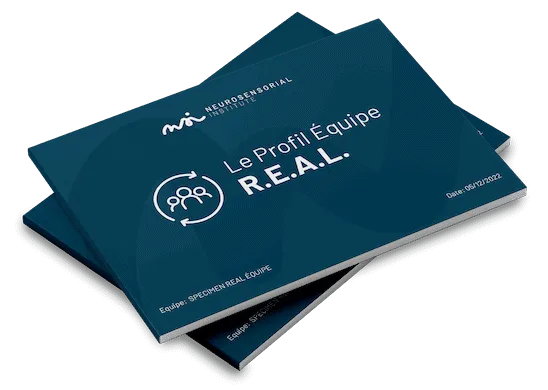
Each member takes their individual profile; the team profile averages the results to shed light on how the team works together. It is free for certified practitioners.
A mobile app is on its way: REALSWITCH
Under stress, the brain switches to autopilot. REALSWITCH teaches you to notice it in a few seconds, several times a day, and take back control.
 The M.A.P., free: three questions to observe yourself (thoughts, emotion, body).
 Reminders during the day and a one-minute neurosensory breathing exercise when you feel tense.
 Your progress: after 21 days, see how your stress changes.
 Next: your R.E.A.L. Profile and the 30-day training right in the app.
Coach, trainer or HR professional?
Get certified to offer and debrief the R.E.A.L. Profile.